
 English

D-Robotics RDK X5 vs Raspberry Pi: A New Era of Edge AI Development
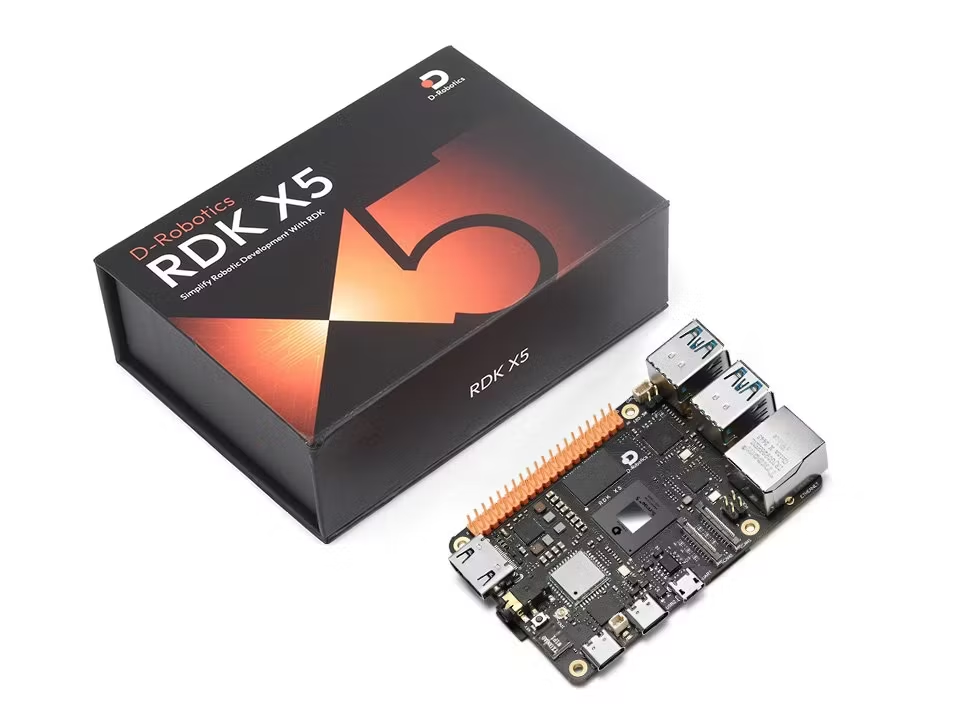
The D-Robotics RDK X5 Dev Board (Sunrise 5) is not just another single-board computer—it represents a shift toward AI-first hardware design. While platforms like the Raspberry Pi have long dominated education and hobbyist development, the RDK X5 targets a different audience: developers working with robotics, computer vision, and edge AI systems.
Buy here
RDK X5 8GB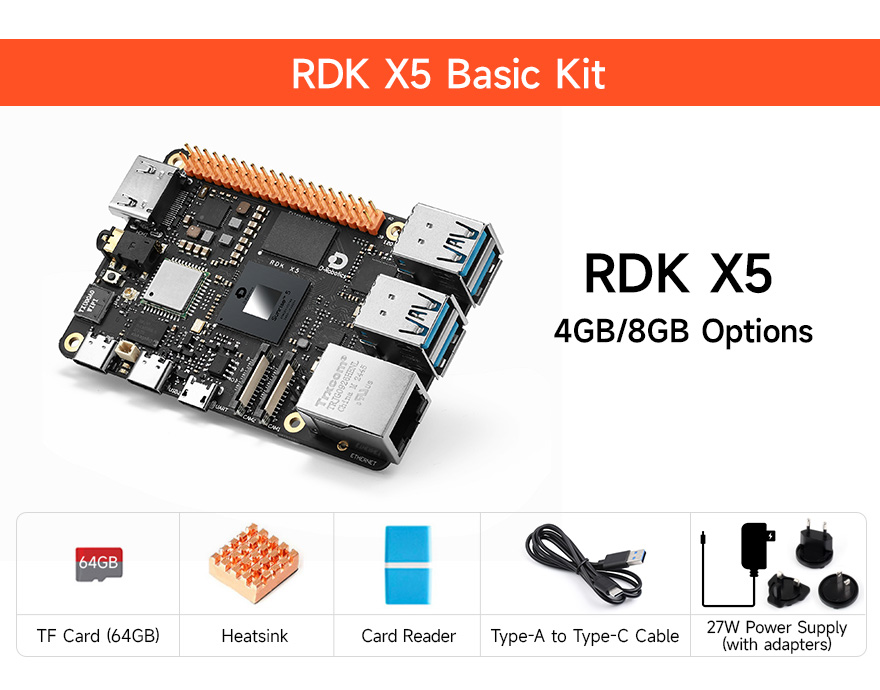
Built for AI From the Ground Up
Unlike general-purpose boards, the RDK X5 integrates a dedicated AI accelerator (BPU/NPU) capable of delivering up to 10 TOPS of performance.
This is a crucial difference. Instead of relying solely on CPU or GPU computation, the board can efficiently execute neural networks such as:
- YOLO object detection
- Transformer-based models
- Stereo vision and depth estimation
- Optical flow and occupancy detection
These workloads are increasingly common in autonomous systems, robotics, and industrial AI, where real-time inference is required without cloud latency.
Hardware Designed for Real-World Robotics
The RDK X5 is powered by an octa-core Arm Cortex-A55 processor combined with 8 GB LPDDR4 RAM, providing a strong balance between general computing and AI acceleration.
But what truly sets it apart is its hardware ecosystem:
- Wi-Fi 6 & Bluetooth 5.4 for modern connectivity
- CAN FD support for industrial and automotive communication
- Multiple MIPI-CSI camera inputs for machine vision
- PoE (Power over Ethernet) for simplified deployment
- USB 3.0 and high-speed I/O for sensor integration
These features make it ideal for ROS (Robot Operating System) environments and embedded AI systems where multiple sensors and real-time processing are required.
Software and Developer Ecosystem
The RDK X5 runs Linux (Ubuntu 22.04) and supports popular AI frameworks such as:
- TensorFlow
- PyTorch
- ROS / ROS2
It also provides SDKs, Python APIs, and pre-built examples, lowering the barrier for developers transitioning from platforms like Raspberry Pi.
This combination of hardware acceleration + software tooling positions the board as a serious development platform—not just a prototyping tool.
Why Raspberry Pi Has Become More Expensive
The rising cost of Raspberry Pi boards is largely driven by:
- Increased RAM prices
- Ongoing global semiconductor shortages
- Higher demand across industries
These factors have pushed prices up across models like the Pi 4 and Pi 5, especially in configurations with more memory.
However, even with these price increases, Raspberry Pi remains fundamentally a general-purpose computing platform—not an AI-specialized system.
RDK X5 vs Raspberry Pi: Different Philosophies
The comparison between the two platforms is less about “which is better” and more about intended use case:
Raspberry Pi
- Best for learning, prototyping, and general computing
- Massive community and ecosystem
- Lower barrier to entry
RDK X5
- Designed for edge AI and robotics
- Built-in 10 TOPS AI acceleration
- Industrial-grade interfaces and sensor support
- Optimized for real-time inference and autonomy
Final Perspective
The RDK X5 can be seen as an “AI robotics core”, rather than a traditional microcomputer. It is purpose-built for developers who need to deploy intelligent systems directly on-device—whether in robots, smart cameras, or industrial automation.
In that context, the higher price is not just justified—it reflects a fundamentally different category of hardware. As AI continues moving toward the edge, platforms like the RDK X5 are likely to become increasingly important, complementing rather than replacing general-purpose boards like the Raspberry Pi.