
 Svenska

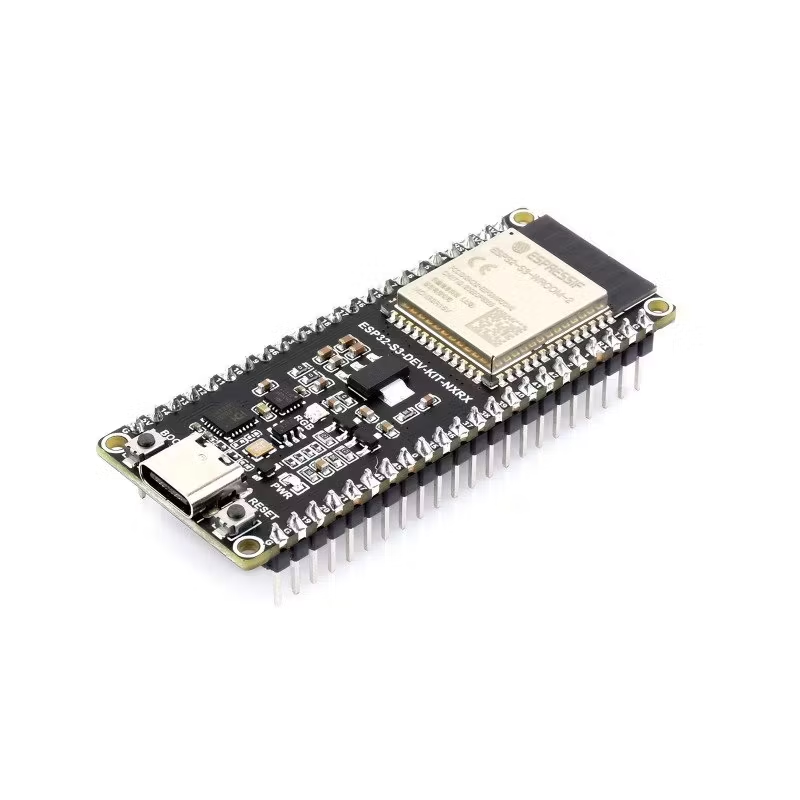
The Waveshare ESP32-S3 Dev Kit is a powerful yet compact platform for developers building IoT devices, embedded systems, and edge AI applications. Based on Espressif’s ESP32-S3 microcontroller, it combines wireless connectivity, efficient processing, and flexible memory configurations in a single board.
In this article, we break down:
- The internal architecture of the ESP32-S3
- How memory is structured and why it matters
- Differences between available board variants
- How it compares to ESP32-C6 and ESP32-S2
1. Architecture Overview
6
The ESP32-S3 is built around a dual-core Xtensa LX7 processor, running at up to 240 MHz. Unlike traditional microcontrollers, it integrates both connectivity and compute capabilities.
Key components:
- Dual-core CPU for multitasking
- Integrated Wi-Fi (2.4 GHz) and Bluetooth LE 5
- SIMD vector instructions for DSP and TinyML
- Native USB OTG (device and host support)
- External Flash and PSRAM interface
What this means in practice
The ESP32-S3 uses a CPU-driven AI model rather than a dedicated accelerator. This gives developers flexibility, but also defines its limits—it excels at lightweight inference, not heavy neural networks.
2. Memory Layout Explained
6
Memory is one of the most important aspects when choosing an ESP32-S3 board.
Memory breakdown:
| Type | Role |
|---|---|
| Internal SRAM | Fast execution, RTOS, stack |
| Flash (8–16 MB) | Firmware, OTA updates, filesystem |
| PSRAM (8 MB) | Buffers, AI tensors, runtime data |
Why Flash vs PSRAM Matters
- Flash size determines how large your firmware and storage can be
- PSRAM size determines how complex your runtime workload can be
Example workflow:
Camera / Sensor → PSRAM buffer → CPU processing → Wi-Fi transmission
For AI applications:
- PSRAM is used for model data and intermediate tensors
- Flash stores the model itself
3. ESP32-S3 Dev Kit Variants
The Waveshare lineup includes four main versions, differing only in Flash size and physical layout.
ESP32-S3-DEV-KIT-N8R8
- 8 MB Flash
- 8 MB PSRAM
- No pre-soldered headers
✔ Best for custom hardware and production integration
ESP32-S3-DEV-KIT-N8R8-M
- 8 MB Flash
- 8 MB PSRAM
- Pre-soldered headers
✔ Best for breadboarding and quick prototyping
ESP32-S3-DEV-KIT-N16R8
- 16 MB Flash
- 8 MB PSRAM
- No headers
✔ Best for larger firmware, OTA, and web-based interfaces
ESP32-S3-DEV-KIT-N16R8-M
- 16 MB Flash
- 8 MB PSRAM
- Pre-soldered headers
✔ Best all-around choice for advanced development
4. Choosing the Right Variant
Selecting the right board depends on your project requirements.
Choose 8 MB Flash if:
- You are building simple IoT nodes
- Firmware size is small
- Cost matters
Choose 16 MB Flash if:
- You need OTA updates
- You run web servers or dashboards
- You store assets or AI models
Choose “-M” versions if:
- You want fast setup without soldering
- You use breadboards or dev rigs
5. ESP32-S3 vs ESP32-C6 vs ESP32-S2
7
Understanding where the ESP32-S3 fits requires comparing it to other ESP32 chips.
Quick Comparison
| Feature | ESP32-S3 | ESP32-C6 | ESP32-S2 |
|---|---|---|---|
| CPU | Dual-core LX7 | Single-core RISC-V | Single-core LX7 |
| AI Capability | SIMD (TinyML) | Minimal | Minimal |
| Wi-Fi | Wi-Fi 4 | Wi-Fi 6 | Wi-Fi 4 |
| Bluetooth | BLE 5 | BLE 5 | No |
| Zigbee / Thread | No | Yes | No |
| USB | Yes | Limited | Yes |
When to Choose Each
ESP32-S3
- Best for AI-enabled IoT and general embedded systems
ESP32-C6
- Best for future-proof IoT (Matter, Thread, Zigbee)
ESP32-S2
- Best for simple, cost-sensitive designs
6. Performance Expectations
The ESP32-S3 is optimized for efficiency, not raw power.
What it does well:
- IoT communication (MQTT, HTTP, BLE)
- Real-time control systems
- Audio processing and TinyML
- Sensor data processing
Limitations:
- Not suitable for heavy computer vision
- Limited performance for large ML models
- No GPU or NPU acceleration
7. Use Cases
Typical applications include:
- Smart IoT sensors
- Voice-controlled devices
- Industrial monitoring systems
- Robotics control nodes
- Edge AI (TinyML inference)
Final Thoughts
The Waveshare ESP32-S3 Dev Kit is a highly capable microcontroller platform that bridges the gap between traditional embedded systems and modern AI-enabled devices.
The key decision points are simple:
- 8 MB vs 16 MB Flash → storage and scalability
- Headers vs no headers → development convenience
For most developers:
👉 The ESP32-S3-DEV-KIT-N16R8-M offers the best balance of performance, flexibility, and ease of use.